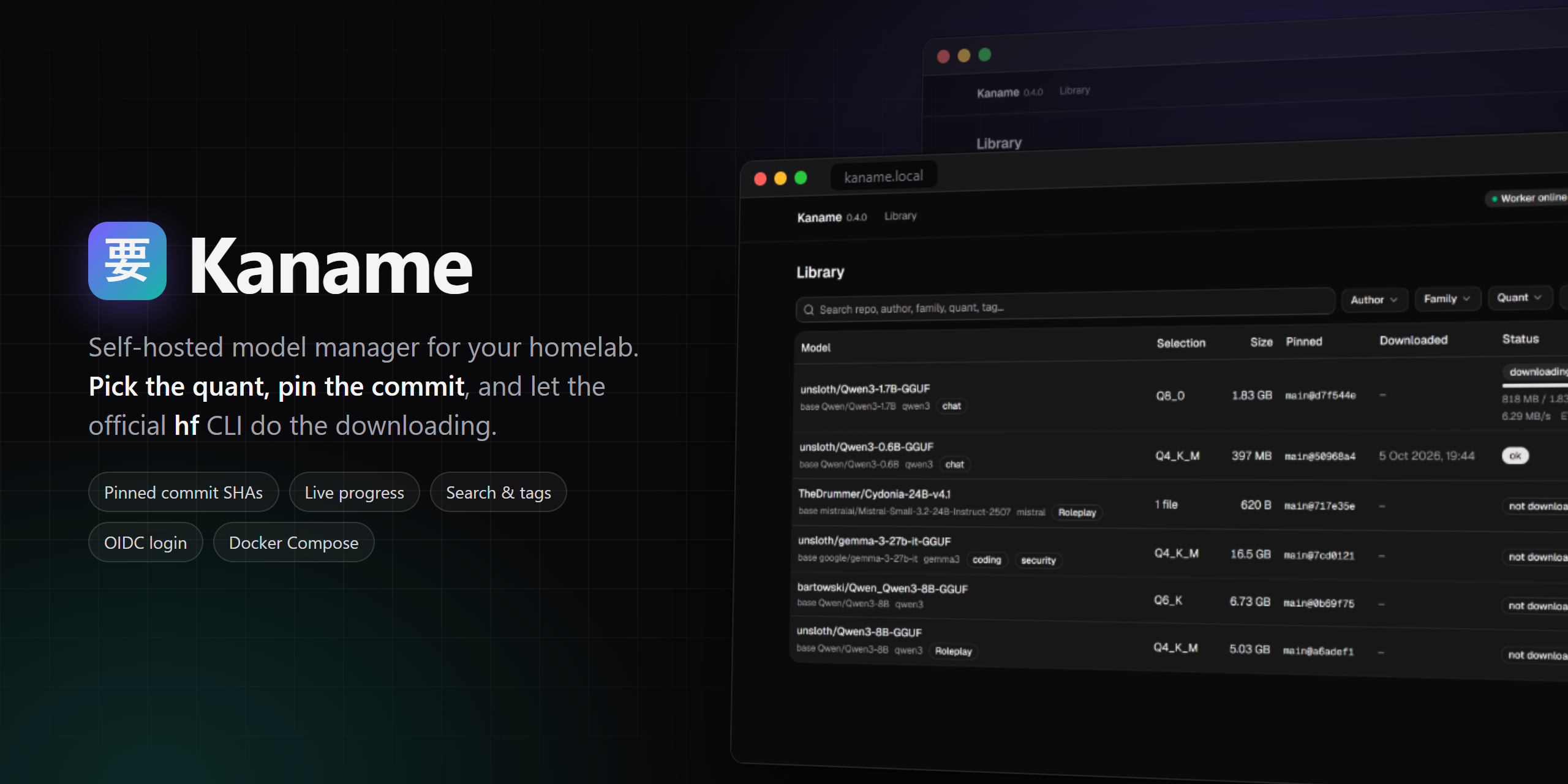
**Kaname** (要, "the pivot") is a self-hosted web app for downloading and managing local LLMs from
Hugging Face. Look up a repo, pick the quant you want, and Kaname downloads exactly those files with
the official `hf` CLI, pinned to a specific commit so every download is reproducible.
- **Pick files, not whole repos:** one-click quant selection for GGUF repos, or include/exclude globs.
- **Pinned and reproducible:** every model is pinned to the exact commit SHA you reviewed.
- **Downloads in the background:** live progress, speed and ETA per file; keeps going when you close
the browser; cancel any time.
- **Find things again:** search and filter by author, model family (e.g. Qwen, Gemma), quant, status
and your own tags like `roleplay` or `security`.
- **Homelab-friendly:** two containers, SQLite, OIDC single sign-on (e.g. Pocket ID), models on any
folder or NAS share.
## Install
You need Docker with Compose and an OIDC provider (e.g. [Pocket ID](https://pocket-id.org)).
**1. Get the compose file and the config template**
```bash
mkdir kaname && cd kaname
curl -fsSLo compose.yaml https://git.linxweiler.xyz/pascallinxweiler/Kaname/raw/branch/main/deploy/compose.yaml
curl -fsSLo .env https://git.linxweiler.xyz/pascallinxweiler/Kaname/raw/branch/main/.env.example
```
**2. Create an OIDC client** in your identity provider with the redirect URI
`/api/auth/callback/pocket-id`, e.g. `http://192.168.1.10:3000/api/auth/callback/pocket-id`.
Request the `groups` scope if you want to restrict access by group.
**3. Fill in `.env`.** At minimum: `AUTH_URL` (the address you open in the browser), `AUTH_SECRET`
(`openssl rand -base64 33`), `OIDC_ISSUER`, `OIDC_CLIENT_ID`, `OIDC_CLIENT_SECRET`, and ideally a
read-only `HF_TOKEN`.
**4. Create the folders and start**
```bash
mkdir -p data models && sudo chown 1000:1000 data models
docker compose up -d
```
Open your `AUTH_URL`, sign in, click **Add model**. That's it.
**Updating:** `docker compose pull && docker compose up -d`. To stay on a version, set e.g.
`KANAME_VERSION=0.4.0` in `.env`. The running version is shown next to the app name.
## Configuration
All settings live in `.env`. The four steps above cover the required ones; the **[configuration
reference in the wiki](https://git.linxweiler.xyz/pascallinxweiler/Kaname/wiki/Configuration)**
lists every option with defaults and examples (folders, ports, download tuning, OIDC groups, which
Hugging Face token to use).
Models end up in `///`, e.g. `models/unsloth/Qwen3-8B-GGUF/`.
More guides are in the [wiki](https://git.linxweiler.xyz/pascallinxweiler/Kaname/wiki).
## Using it
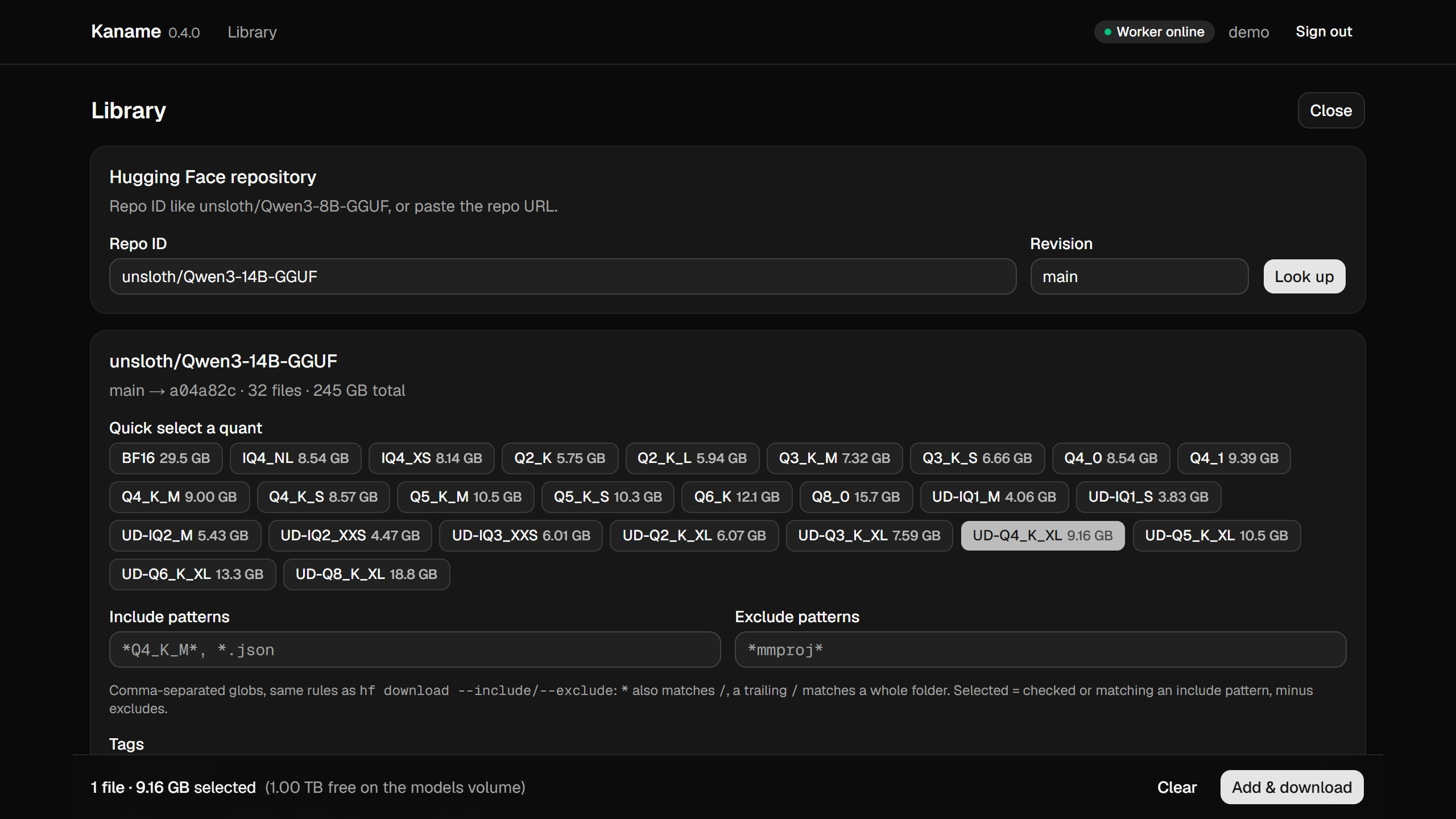
- **Add model:** enter a repo ID like `unsloth/Qwen3-8B-GGUF` (or paste the URL), click a quant, and
**Add & download**. You can add tags right there.
- **Search:** type anything: `unsloth qwen`, `q4_k_m`, `gemma`, `roleplay`. Every word has to match
somewhere (repo, author, base model family, architecture, quant, tags).
- **Filter:** combine Author, Family, Quant, Tag and Status filters. The URL keeps the filters, so
you can bookmark a view.
- **Tags:** add or remove your own tags on a model's page; click a tag in the list to filter by it.
- **Jobs:** each download has a page with per-file progress and the full `hf` log.
## How it works
Two containers from the same image share one SQLite database:
- **web:** Next.js UI and API, OIDC login (Auth.js); live updates via Server-Sent Events.
- **worker:** runs the download queue, spawns `hf download --revision --include `, and
measures progress from bytes on disk. Only one worker runs at a time.
Notes on the `hf` CLI (huggingface_hub 2.1.1, pinned in the image):
- Interrupted files are **not resumed**: a re-run skips finished files and restarts unfinished ones.
Kaname cleans up the leftover partial files.
- With Xet transfers the partial file only grows in large bursts, so Kaname disables Xet by default
to show accurate progress.
- `hf` exits successfully even if nothing matched, so Kaname checks every file's size and hash
metadata after each download.
## Development
```bash
npm install
cp .env.example .env # plus DATABASE_URL=file:./data/app.db and MODELS_DIR=./data/models
npm run dev # web on http://localhost:3000 + worker
```
The worker needs `hf` on `PATH` (`pip install "huggingface_hub[hf_xet]==2.1.1"`). Without it,
everything but downloading works. `docker compose up --build` (root `compose.yaml`) builds and runs
the image locally.
| Script | What it does |
| --- | --- |
| `npm run dev:web` / `npm run dev:worker` | run one side only |
| `npm test` | unit tests |
| `npm run typecheck`, `npm run lint` | checks |
| `npm run db:generate` | new migration after changing `src/lib/db/schema.ts` |
| `npm run build:worker` | bundle worker + migrate script into `dist/` (used by the image) |
**Releases:** bump `version` in `package.json`, add a `## [X.Y.Z]` section to
[`CHANGELOG.md`](CHANGELOG.md), commit and push a `vX.Y.Z` tag. Gitea Actions
([`.gitea/workflows/release.yaml`](.gitea/workflows/release.yaml)) runs the checks, pushes
`git.linxweiler.xyz/pascallinxweiler/kaname:X.Y.Z` (+ `X.Y`, `latest`) and creates the release.
It needs an `act_runner` with Docker access and a `REGISTRY_TOKEN` repo secret (package read/write).